Maintaining Indoor Air Quality During Wildfires Gelair Solutions
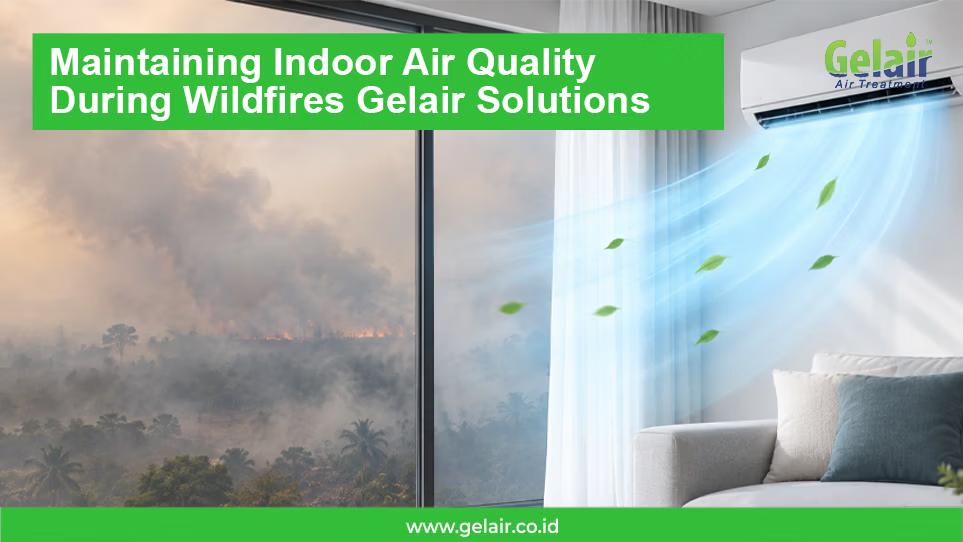
Forest and land fires (karhutla) not only cause environmental damage, but can also have a direct impact on the quality of the air we breathe. Smoke from forest and land fires can spread over a fairly wide area and cause the air to become hazy, smell like smoke, and contain various particles and pollutants.
Under these conditions, maintaining indoor air quality becomes essential, especially in homes, offices, hotels, schools, hospitals, and public facilities. One effort that can be made is optimizing indoor air treatment systems with Gelair Air Treatment.
Why Is Smoke from Forest and Land Fires Dangerous for Air Quality?
The smoke produced by forest and land fires is a complex mixture that can contain fine particulate matter, gases, and various combustion byproducts. One of the main concerns is particulate matter (PM2.5), which are extremely small particles that can penetrate deep into the respiratory system.
When outdoor air quality deteriorates due to smoke from forest and land fires, that air also has the potential to enter buildings through:
- Doors and windows that are frequently open.
- Gaps in the building structure.
- Ventilation systems.
- Air conditioning (AC) systems.
- People entering and exiting.
Therefore, relying solely on outdoor air for ventilation is not necessarily the right choice when outdoor air quality is poor.
The Impact of Smoky Air on Indoor Comfort
When smoke from forest and land fires enters a room, several conditions that can be felt include:
- An annoying smoke odor.
- Air that feels uncomfortable to breathe.
- Dust and particles accumulating more easily.
- Room surfaces getting dirty faster.
- Decreased indoor air quality.
For groups that are more sensitive to air quality, such as children, the elderly, and people with certain respiratory conditions, poor air conditions require extra attention. Therefore, indoor air quality management needs to be part of the mitigation steps during forest and land fires.
How to Maintain Air Quality During Forest and Land Fires?
Maintaining indoor air quality during forest and land fires should be done through several simultaneous steps.
1. Monitor air quality
Pay attention to air quality information from official sources and surrounding environmental conditions. If outdoor air quality is poor, reduce outdoor activities and consider restricting outdoor air from entering the building.
2. Reduce smoke entry into rooms
Ensure unnecessary doors, windows, and building gaps are properly closed when outdoor air conditions are smoky.
3. Maintain AC systems regularly
AC is not just for cooling rooms. The AC system also plays a role in indoor air circulation and management. Dirty filters and AC components can reduce system effectiveness and become places where dust and contaminants accumulate. Because of this, periodic AC cleaning and maintenance remain important, especially during periods when outdoor air quality is poor.
4. Use additional air treatment technology
In addition to keeping AC systems clean, using air treatment technology can be part of a strategy to help maintain indoor air quality. One such option is Gelair Air Treatment.
Gelair Air Treatment as a Solution to Support Air Quality
Gelair Air Treatment is designed as an air treatment solution that can be applied to HVAC systems and areas requiring air quality management.
In environmental conditions with increased levels of pollution and smoke, such as during forest and land fires, air management should not focus solely on room temperature. Air quality also needs attention.
Gelair can be part of an air quality management approach by helping maintain the condition of HVAC systems and the indoor air environment so that it remains better controlled.
Gelair Coil & Duct
Gelair Coil & Duct can be applied to coil and ducting areas in HVAC systems. Coil and duct areas are vital parts of air conditioning systems. Over time, these parts can experience an accumulation of various contaminants that can affect system condition and air quality.
The application of Gelair Coil & Duct helps support cleanliness management and HVAC system conditions so that the air conditioning system can operate in a better-maintained environment. This product can be part of an air quality management program, especially in:
- Hotels.
- Offices.
- Hospitals.
- Schools.
- Shopping centers.
- Commercial buildings.
- Industrial facilities.
- Buildings with centralized HVAC systems.
Gelair Block
In addition to application in HVAC systems, Gelair Block can be used as part of an air treatment solution in specific areas according to needs. Gelair Block can be placed in areas that have air circulation and require support for air quality management
The use of Gelair Block can serve as a complement in air management strategies, especially when buildings need a practical solution to help maintain air conditions in specific areas
Don't Focus Only on Outdoor Air
When forest and land fires occur, public attention is usually focused on outdoor air conditions. However, air quality inside buildings also needs attention.
Closing windows alone is not always enough. Buildings still require properly maintained air conditioning systems and appropriate air quality management strategies.
The approach that can be taken includes:
Monitor air quality → reduce smoke entry → maintain AC/HVAC → manage system cleanliness → use air treatment as needed.
With this approach, air quality management can be carried out more comprehensively.
Gelair Air Treatment for a More Comfortable Environment
Forest and land fires are an environmental issue whose impact can be felt all the way into urban areas. When smoke and pollutants spread, air quality can decline and affect the comfort of daily activities.
Therefore, maintaining indoor air quality should not only be done when air conditions are already bad. Maintenance and management of air conditioning systems should be carried out regularly as a preventive step.
Gelair Air Treatment is present as part of air quality management solutions through the application of Gelair Coil & Duct and Gelair Block, which can be tailored to the needs of buildings and air conditioning systems.
Better managed air means a more comfortable indoor environment for activities.
Gelair Air Treatment — solutions to help maintain air quality, from HVAC systems to the spaces we use every day.
FAQ Regarding Forest and Land Fires and Air Quality
- Can smoke from forest and land fires get indoors? Yes. Smoke can enter through doors, windows, building gaps, ventilation, or air conditioning systems, depending on the condition and design of the building.
- Can AC remove smoke from forest and land fires? Not all AC systems are designed to eliminate all components of smoke or pollutants. Its effectiveness depends on the type of system, filters, ventilation, and air treatment devices used.
- Why does AC need maintenance during smoky air conditions? AC and HVAC systems are part of a building's air circulation system. Routine maintenance helps keep components clean and supports the performance of the air conditioning system.
- What is the function of Gelair Coil & Duct? Gelair Coil & Duct is used as part of managing and maintaining coil and ducting areas in HVAC systems.
- What is the function of Gelair Block? Gelair Block is an air treatment product that can be applied to specific areas according to air management needs.
- Does Gelair replace the use of masks or other protective measures during forest and land fires? No. Gelair is part of an indoor air quality management strategy. When forest and land fires occur, other protective measures such as monitoring air quality, reducing smoke exposure, using appropriate respiratory protection, and following health authority guidelines remain essential.